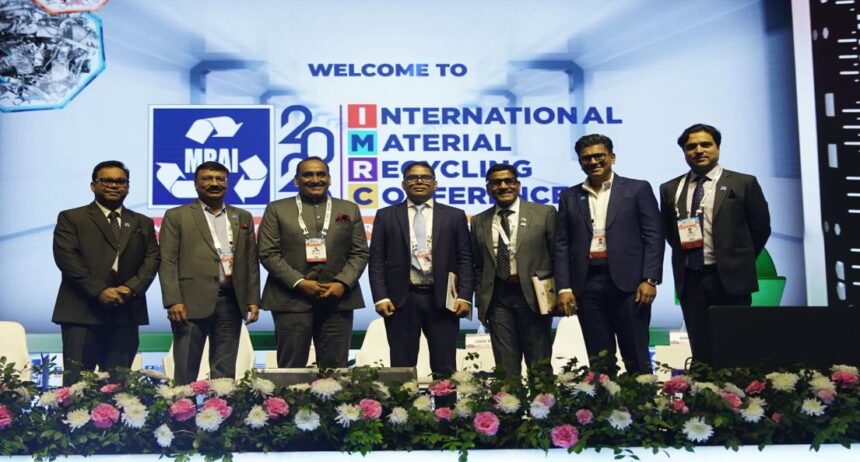
India’s demand for steel scrap is expected to grow significantly as the country expands its steelmaking capacity, according to Shri Daya Nidhan Pandey, Joint Secretary, Ministry of Steel. Speaking at the inaugural session of the 13th International Material Recycling Conference and Exposition (IMRC 2026) in Jaipur, Pandey highlighted the increasing importance of scrap-based steel production in India’s industrial and decarbonisation journey.
He noted that scrap currently accounts for around 21 percent of India’s crude steel output, which remains below the global average of nearly one-third. However, scrap consumption in the domestic steel sector has been steadily increasing. With scrap availability projected to reach about 36 million tonnes, demand for recycled steel inputs is expected to rise sharply as large-scale capacity additions gather pace.
Outlining policy initiatives, Pandey said the government has adopted a coordinated approach through measures such as the Steel Scrap Recycling Policy 2019, the Vehicle Scrappage Policy, the establishment of Registered Vehicle Scrapping Facilities, and the integration of scrap management within broader circular economy frameworks. He added that recently notified Extended Producer Responsibility requirements for end-of-life vehicles and construction and demolition waste are likely to further strengthen formal scrap recycling systems.
Looking ahead, Pandey said India is working towards increasing the share of scrap in steelmaking closer to the global benchmark of around 31 percent. With steel capacity targeted at 300 million tonnes by 2030 and 500 million tonnes by 2047, recycled scrap will play a critical role in conserving natural resources, reducing dependence on coal imports, cutting emissions, and supporting India’s goal of achieving net zero by 2070. He emphasised that scrap-based steelmaking contributes directly to decarbonisation by reducing reliance on iron ore and coking coal.
Addressing industry challenges, Shri Sanjay Mehta, President of the Material Recycling Association of India (MRAI), called for policy rationalisation to support the recycling ecosystem. He said the industry has been seeking a reduction in GST on scrap to 5 percent, as higher tax rates are constraining growth and encouraging non-compliance. He also urged the removal of import duties on aluminium scrap and stronger enforcement of Extended Producer Responsibility across e-waste, tyres, and plastics to protect the integrity of the recycling value chain.
Mehta also highlighted the social aspects of recycling, noting that a substantial portion of scrap collection in India comes from ragpickers, households, and small workshops. He said encouraging digital payments through UPI at the first point of scrap collection and discouraging cash transactions could help integrate informal workers into the formal economy in a more sustainable and dignified manner.
Commenting on industry evolution, Shri Dhawal Shah, Senior Vice President, MRAI, said recycling in India has moved beyond being a corporate social responsibility initiative and has become a core business strategy. He pointed out that more than 1,400 start-ups are currently active in waste management and sustainability, and at the current growth rate, the recycling sector could overtake mining in scale well before 2050.
Shri Zain Nathani, Vice President, MRAI, described the recycling industry as a potential game changer for India, adding that rationalisation of duties and supportive government policies would further accelerate growth. Shri Amar Singh, Secretary General, MRAI, noted that the sector has undergone a significant transformation and is poised to make larger contributions to the national economy.
Highlighting the role of finance, Shri Rajat Agarwal, Managing Director of Gravita India Limited, said access to capital is no longer a major constraint for responsible recyclers. He observed that global green funds and ESG-focused investors are increasingly supporting scalable recycling businesses that combine financial performance with environmental impact. According to him, strong governance, policy support such as EPR, and India’s circular economy vision are positioning Indian recyclers as globally competitive providers of climate solutions.
Organised by the Material Recycling Association of India, IMRC 2026 is being held from 20 to 22 January at the Novotel Jaipur and Convention Centre. The three-day event has brought together policymakers, industry leaders, and international stakeholders to discuss the role of recycling in sustainable industrial growth, with sessions focusing on sustainability, climate action, energy storage, circular economy transitions, and long-standing regulatory and market challenges.