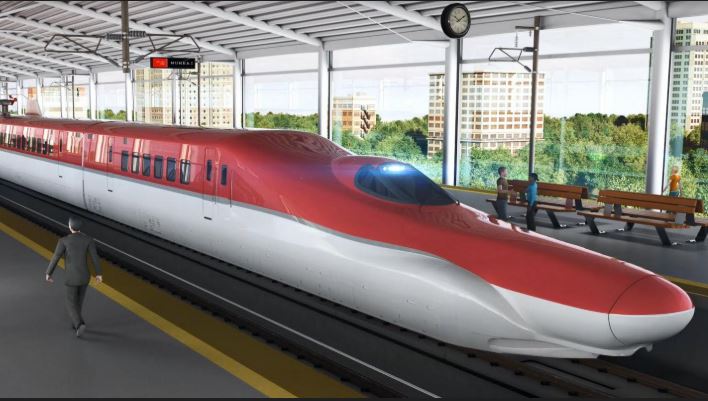
India’s effort to build its first domestically designed and manufactured high-speed train is progressing steadily, with the project’s design phase now nearing completion and preparations underway to begin production by mid-2026, according to people familiar with the development.
The initiative, aimed at developing trainsets for deployment on the Mumbai–Ahmedabad High-Speed Rail (HSR) corridor, is being carried out by a consortium led by Bharat Earth Movers Limited (BEML) in partnership with Medha Servo Drives. The work was commissioned by the Integral Coach Factory (ICF) in 2024 and involves creating two high-speed trainsets, each with eight coaches.
These trainsets are being engineered to operate at a service speed of 250 km/h with a top design speed of 280 km/h, and are expected to be tested and certified ahead of commercial operations on the high-speed corridor.
Officials involved in the project say that various components including the carbody, bogies, suspension systems, and doors are in the final stages of design and development. Once the complete design is finalised, production activities encompassing fabrication and assembly are anticipated to begin between April and June 2026. Manufacturing will be spread across different facilities, with BEML’s Bengaluru plant expected to handle carbody fabrication and Medha’s Hyderabad facility producing bogies and related systems. Engineers are also integrating advanced train control and management systems and working on signalling interfaces to ensure the trainsets meet high-speed operation and safety requirements.
The first prototype trainset is targeted for rollout by December 2026, after which it will undergo a series of rigorous tests including static and high-speed dynamic trials and certification by the Research Designs and Standards Organisation (RDSO) before being cleared for future passenger service.
Once testing is complete, the initial trainsets are likely to be used on select sections of the corridor before broader commercial operations begin. The Mumbai–Ahmedabad high-speed line itself is being developed in phases, with the first segments expected to open for passenger service starting in 2027. This indigenous high-speed train project marks a significant step toward localisation of high-speed rail capability in India and supports broader national goals of building advanced rail infrastructure with stronger domestic technology participation.