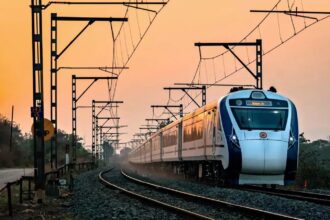
Train-handling capacity in three key cities under the East Coast Railway zone — Bhubaneswar, Puri and Visakhapatnam — is set for a significant boost over the next five years, according to Union Railway Minister Ashwini Vaishnaw. The initiative aims to nearly double the operational capacity of these rail hubs as part of a larger, nationwide infrastructure programme.
The minister explained that these cities are among 48 major urban centres identified for time-bound rail capacity enhancement, with a planned horizon extending up to 2030. The expansion roadmap brings together already approved projects, works currently in progress and new proposals. Importantly, the improvements will not be backloaded, as capacity additions will be introduced in phases so that passengers experience tangible benefits well before the end of the decade.
The strategy focuses on strengthening both terminal and sectional capacity. Existing stations will see an increase in platforms, pit lines, stabling arrangements and shunting facilities. At the same time, new satellite terminals are planned in nearby urban pockets to ease pressure on main stations and distribute traffic more efficiently.
Beyond station upgrades, the programme includes large-scale maintenance infrastructure, advanced signalling systems, traffic facility enhancements and multitracking of busy sections. Expansion efforts will extend to surrounding stations as well, ensuring smoother train movement and more balanced network growth across the region.
A structured master plan has been prepared, dividing the work into immediate, short-term and long-term phases, each with clearly defined targets. The objective is to reduce congestion, accommodate rising passenger demand and improve overall connectivity on the eastern rail corridor.
Several projects are already taking shape on the ground. In Puri, construction is underway on two full-length integrated pit lines, while the existing coaching maintenance unit will be relocated to a second depot along the sanctioned Puri–Konark line. This site is planned to host a large, modern coaching complex.
In Bhubaneswar, a new station is being developed as a satellite terminal to support the main junction. Additional pit lines are planned at Mancheswar, with new maintenance depots proposed on the city’s outskirts due to space constraints in the core area.
For Visakhapatnam, a comprehensive yard remodelling proposal is currently under review by the Railway Board. In parallel, Jaganadhpuram has been identified for a major coaching maintenance facility on a new bypass line. The city will also benefit from multiple signalling upgrades, flyovers and bypass projects aimed at improving train flow and operational efficiency.
Together, these measures are expected to transform rail operations across the East Coast Railway network, making it better equipped to handle future growth while delivering faster and more reliable services to passengers.Train-handling capacity in three key cities under the East Coast Railway zone — Bhubaneswar, Puri and Visakhapatnam — is set for a significant boost over the next five years, according to Union Railway Minister Ashwini Vaishnaw. The initiative aims to nearly double the operational capacity of these rail hubs as part of a larger, nationwide infrastructure programme.
The minister explained that these cities are among 48 major urban centres identified for time-bound rail capacity enhancement, with a planned horizon extending up to 2030. The expansion roadmap brings together already approved projects, works currently in progress and new proposals. Importantly, the improvements will not be backloaded, as capacity additions will be introduced in phases so that passengers experience tangible benefits well before the end of the decade.
The strategy focuses on strengthening both terminal and sectional capacity. Existing stations will see an increase in platforms, pit lines, stabling arrangements and shunting facilities. At the same time, new satellite terminals are planned in nearby urban pockets to ease pressure on main stations and distribute traffic more efficiently.
Beyond station upgrades, the programme includes large-scale maintenance infrastructure, advanced signalling systems, traffic facility enhancements and multitracking of busy sections. Expansion efforts will extend to surrounding stations as well, ensuring smoother train movement and more balanced network growth across the region.
A structured master plan has been prepared, dividing the work into immediate, short-term and long-term phases, each with clearly defined targets. The objective is to reduce congestion, accommodate rising passenger demand and improve overall connectivity on the eastern rail corridor.
Several projects are already taking shape on the ground. In Puri, construction is underway on two full-length integrated pit lines, while the existing coaching maintenance unit will be relocated to a second depot along the sanctioned Puri–Konark line. This site is planned to host a large, modern coaching complex.
In Bhubaneswar, a new station is being developed as a satellite terminal to support the main junction. Additional pit lines are planned at Mancheswar, with new maintenance depots proposed on the city’s outskirts due to space constraints in the core area.
For Visakhapatnam, a comprehensive yard remodelling proposal is currently under review by the Railway Board. In parallel, Jaganadhpuram has been identified for a major coaching maintenance facility on a new bypass line. The city will also benefit from multiple signalling upgrades, flyovers and bypass projects aimed at improving train flow and operational efficiency.
Together, these measures are expected to transform rail operations across the East Coast Railway network, making it better equipped to handle future growth while delivering faster and more reliable services to passengers.