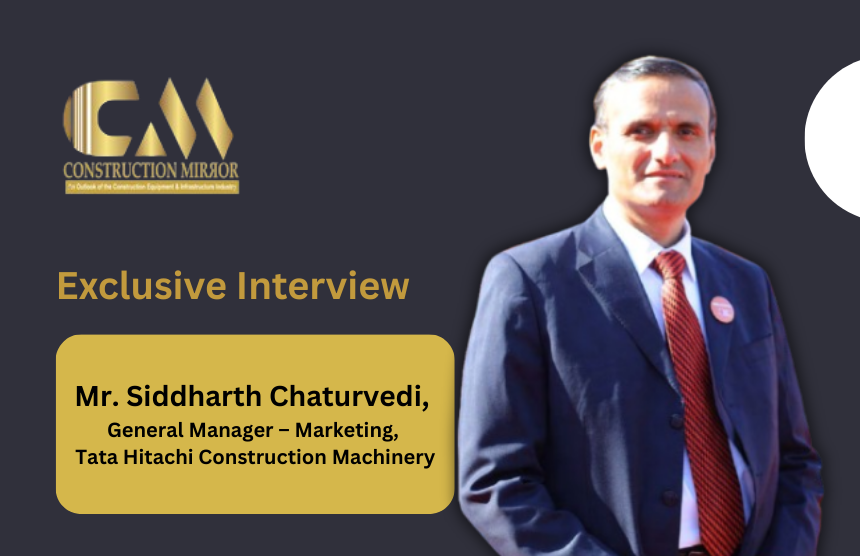
Over the next decade, India is poised to become one of the world’s major CE markets as infrastructure investment, electrification, and digitalisation converge. Our leadership will be shaped by a unified approach where technology, sustainability, and customer-centricity operate together, not as separate elements. The next chapter of Tata Hitachi
will bring electrification, advanced automation, and circular manufacturing practices into a common framework to
deliver meaningful value.
Q. Tata Hitachi has long represented trust and technology in India’s construction sector. As the company embraces sustainability, digitalisation, and large infrastructure projects, how do you define its long-term vision through smart machines, deeper localisation, or a customer-focused ecosystem shaping the future of construction equipment?
Tata Hitachi’s long-term vision is centred on shaping a future-ready construction ecosystem for India, one that is efficient, sustainable, and truly customer-driven. As the sector transforms, our approach extends well beyond equipment manufacturing. We are integrating advanced digital platforms, intelligent machine technologies, and deeper localisation to boost productivity and enhance lifecycle value. At the core of this vision is our commitment to deliver machines and services that are intuitive, dependable, and aligned with India’s infrastructure goals ensuring customers gain real, measurable outcomes rather than just
operational capability.
Q. As India’s infrastructure landscape evolves from metro networks to greenfield industrial corridors, how is Tata Hitachi seeing demand shift across its equipment segments, and how is the company adapting its product roadmap to meet these changing project requirements?
We are seeing strong growth across three major segments: compact machinery driving last-mile urban development, mid-range excavators powering national highway and utility works, and high-capacity mining equipment supporting India’s expanding energy and mineral sectors. In response to this shift, our roadmap prioritises platform-based product enhancements, alternative energy options, advanced control technologies, and next-generation operator comfort and safety features. This strategy keeps us closely aligned with India’s evolving project landscape from metro networks and smart cities to dedicated industrial corridors and new greenfield development zones.
Q. Tata Hitachi’s manufacturing operations are recognised for advanced capabilities. How is the company deepening localisation not just in components but also in design, engineering, and talent development while ensuring that every
“Made in India” machine meets global Hitachi quality standards?
For us, localisation has evolved beyond sourcing, it now reflects true capability ownership. We are strengthening domestic value through indigenous engineering and comprehensive supplier development. Alongside this, we uphold rigorous global quality standards and performance validation protocols across our Kharagpur and Dharwad plants. At the same time, we are investing in people building specialised expertise in automation, system engineering, and powertrain technologies. This ensures every Tata Hitachi machine carries a proud ‘Designed, Developed, and Made in India’ identity that meets international benchmarks.
Q. India’s infrastructure and mining sectors are poised for rapid expansion. Which areas highways, ports, renewable energy, or urban development are expected to drive the next wave of CE demand, and how is Tata Hitachi aligning its portfolio, capacities, and partnerships to capture these opportunities?
Demand will continue to be led by highways, renewable energy corridors, rail and metro networks, and large-scale mining projects. At the same time, sectors such as waste management, urban redevelopment, and rural mechanisation are set to become significant growth drivers. To stay ahead, we are strengthening our product lineup across all operating classes, expanding the capabilities of our strategic dealer network, improving parts distribution systems, and forging partnerships for electrification and alternative energy solutions. This approach positions us ahead of demand cycles and enables us to support customers seamlessly from project planning through to execution.
Q. Tata Hitachi’s journey toward 2030 will unfold across technology, sustainability, and customer-focused innovation. Which of these will most strongly define its leadership in India’s infrastructure sector, and what upcoming initiative or launch in the next 12–18 months do you see as a game-changer for the company’s legacy?
Our leadership will be shaped by a unified approach where technology, sustainability, and customer-centricity operate together not as separate elements. The next chapter of Tata Hitachi will bring electrification, advanced automation, and circular manufacturing practices into a common framework to deliver meaningful value. In the coming period, we will roll out a series of transformative initiatives including alternative energy equipment, digital productivity solutions, and strengthened lifecycle offerings marking a significant milestone in our journey toward a more intelligent, sustainable, and customer-focused future.
Q. As EXCON 2025 sets the stage for innovation and industry collaboration, how is Tata Hitachi using this platform to showcase its technological direction, strengthen market connections, and unlock new opportunities for future growth?
Our presence at EXCON 2025 reflects a clear and forward-looking roadmap for the future. We are showcasing product debuts across our electrified platforms, live demonstrations of connected-machine telematics, predictive service solutions, and a comprehensive display of mid-class and high-capacity equipment. The portfolio also includes next-generation midsized excavators, advanced mining solutions, compact machines for urban and rental needs, as well as hybrid and electric variants designed for efficiency and sustainability. Complementing these are operator-assist technologies, integrated fleet-visibility platforms, and a wide range of specialised attachments tailored for India’s diverse project requirements from industrial corridors to urban upgrades and rural development.
EXCON remains a pivotal platform for us. It brings customers, contractors, policymakers, dealers, and technology partners together under one roof, enabling high-impact networking and accelerating business opportunities. The event enhances brand visibility, supports product validation, strengthens dealer and rental partnerships, and serves as a vital indicator of market sentiment making it an essential launchpad for strategic collaborations and capability-building initiatives.
Q. With global shifts reshaping the manufacturing landscape, how do you view the current outlook for India’s construction-equipment sector, and what future do you anticipate for the industry?
India’s construction-equipment industry is moving through a transitional growth phase influenced by both domestic realities and global developments. Internationally, factors such as supply-chain diversification, fluctuations in steel and commodity prices, and tighter global emission and technology standards are shaping the landscape. These dynamics present a mix of challenges ranging from cost pressures to intermittent component shortages as well as clear opportunities in exports,
higher-value engineering, and expanded local manufacturing. Structural demand continues to hold strong, especially from highways, metros, ports, renewable-energy projects, and largescale infrastructure programmes. However, cyclical slowdowns in project awards, a softer real-estate environment, and cost impacts from new emission norms are creating shortterm moderation in domestic volumes. Export demand, meanwhile, is growing steadily and helping balance some of this temporary
softness.
Over the next decade, India is poised to become one of the world’s major CE markets as infrastructure investment, electrification, and digitalisation converge. Realising this potential will require deeper localisation, faster technology adoption, enhanced skill development, and a stronger emphasis on circularity. Companies that commit to these priorities will be well positioned to tap both domestic opportunities and rising global demand.
Q. How is Tata Hitachi’s R&D and product development aligning with emerging trends such as digitalisation, automation, and sustainability in construction machinery?
Our R&D strategy is built around three core pillars that ensure our machines are futureready and aligned with evolving regulatory and operational needs.
Digitalisation is at the forefront, with intelligent machine controls, telematics-driven fleet optimisation, remote diagnostics, and utilisation analytics integrated across our products. Automation focuses on operator-assist systems, work-cycle optimisation, and advanced safety features to enhance precision, reduce fatigue, and improve overall efficiency. Sustainability underpins design and engineering decisions through energy-efficient systems, alternative fuel options, recyclable components, and
lifecycle extension via remanufacturing and rebuild programmes.
Digital technologies are embedded throughout both product and service layers. Telematics provides real-time fleet tracking,
utilisation insights, and remote diagnostics. AI and machine-learning capabilities enable predictive maintenance, anomaly detection, and optimisation of service cycles to minimise downtime. On the operational side, machines feature operator-assist functions such as autoidle, cycle optimisers, and grade-assist and pilot automation for repetitive tasks. These systems are integrated with dealer and customer portals, making actionable insights available for spares management, uptime guarantees, and overall fleet performance. Together, these innovations ensure our machines meet the demands of modern construction while driving efficiency, safety, and sustainability.
Q. What are Tata Hitachi’s key growth priorities for the Indian market over the next three to five years, and how do you plan to capture emerging opportunities?
Our growth priorities for the Indian market over the next three to five years are centred on several strategic initiatives. We aim to accelerate the introduction of electrified and low-emission products to serve urban and regulated markets, while scaling our manufacturing capabilities and strengthening localisation to support both domestic demand and export opportunities. At the same time, we are enhancing digital services and outcome-based solutions that turn machine uptime into measurable customer value. Expanding rental and fleet partnerships will allow us to reach new user segments, and we are investing in our dealer networks and talent ecosystem to sustain aftermarket excellence and drive continued product innovation. Together, these efforts position us to capture growth opportunities while delivering efficiency, sustainability, and value across India’s evolving construction-equipment landscape.