Texas-based steel technology company Hertha Metals has raised $133.65 million in a Series A funding round to finance the construction and initial operations of a new facility in Conroe, Texas, designed to produce high-purity iron and steel for the US market.
The financing includes a $65 million equity investment from the US government through the Department of Defense’s Industrial Base Analysis and Sustainment (IBAS) programme, in partnership with its Economic Defense Unit. Khosla Ventures and Doerr Capital co-led the funding round, which also saw participation from Clean Energy Ventures, Pear Ventures, Gates Frontier, Niterra’s corporate venture fund managed by Global Brain, Toyota Ventures and Siemens Financial Services.
Hertha plans to use the funding to build its approximately $100 million Hertha Chalyx facility. The plant is planned to produce 10,000 tonnes of high-purity iron and steel annually, with most of the output intended for US manufacturers of rare-earth permanent magnets. The company expects to break ground on the facility this year.
High-purity iron is a major component of neodymium-iron-boron (NdFeB) permanent magnets, accounting for nearly 70% of their weight. These magnets are used in electric vehicles, aerospace and defence systems, radar equipment and other applications. Hertha said around 94% of the iron required for such magnets is currently produced in China, highlighting the dependence of the US supply chain on overseas production.
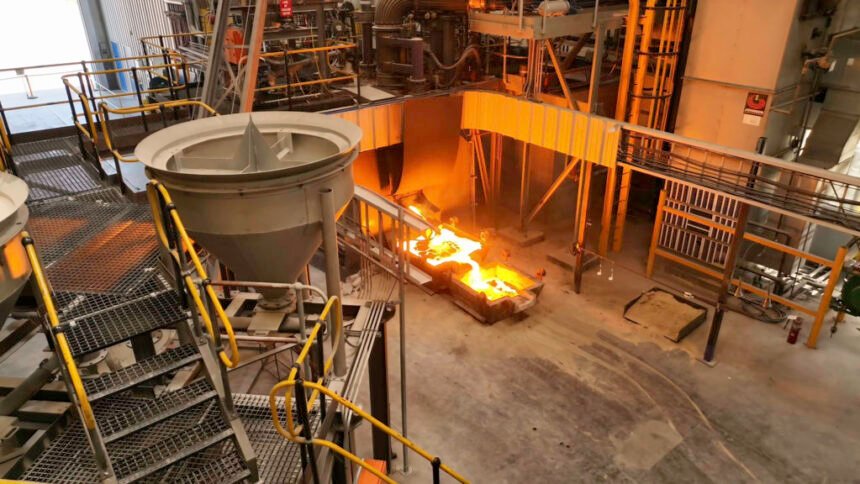
The Chalyx project will use Hertha’s FLEX-HERS technology, which replaces the conventional multi-stage, coal-dependent blast furnace route with a single continuous reduction reactor. The process can work with different grades of iron ore and can use either natural gas or hydrogen as the reducing agent.
According to the company, the technology is designed to produce either high-purity iron or steel by adjusting the carbon content during the process. Hertha estimates that, at commercial scale, its process could reduce production costs by about 25% compared with conventional blast-furnace production. It also estimates emissions reductions of about 50% when natural gas is used and up to 98% when hydrogen is used.
Hertha already operates a 360-tonne-per-year pilot facility in Conroe, located next to the planned Chalyx plant. The pilot facility is being used to demonstrate the technology and support supplier qualification with major US rare-earth magnet manufacturers. The company said it is also finalising commitments with several US magnet producers that could account for a meaningful portion of Chalyx’s planned output.
The company’s focus on magnet-grade iron comes as the US seeks to develop more domestic supply chains for critical materials. Hertha said the Chalyx facility is intended to provide a domestic source of high-purity iron for rare-earth magnet production, while the federal investment is linked to efforts to strengthen the country’s defence industrial base.
Hertha, however, is planning to use the technology beyond the magnet market. The company is developing plans for a subsequent 500,000-tonne commercial iron and steel plant. The facility would target broader steel applications, including high-end steel required for electrical transformers used in data centres and other infrastructure.
The company was founded in 2022 by Laureen Meroueh with the objective of developing an alternative to the conventional primary iron and steelmaking process. Hertha said its technology combines iron production and steelmaking in a single process, potentially allowing the same production platform to serve both high-purity iron and steel markets.
Hertha expects the Chalyx plant to be commissioned in late 2027, with production ramping up to full capacity in 2028. The company plans to source much of the iron ore for the facility from Minnesota’s Iron Range and expects the plant to reach profitability by the end of 2029.
Sources: MINING.com | The Wall Street Journal | Hertha Metals | Houston Chronicle.