The National High Speed Rail Corporation Limited (NHSRCL) has launched the first steel bridge of the Mumbai-Ahmedabad High Speed Rail (MAHSR) project in Maharashtra.
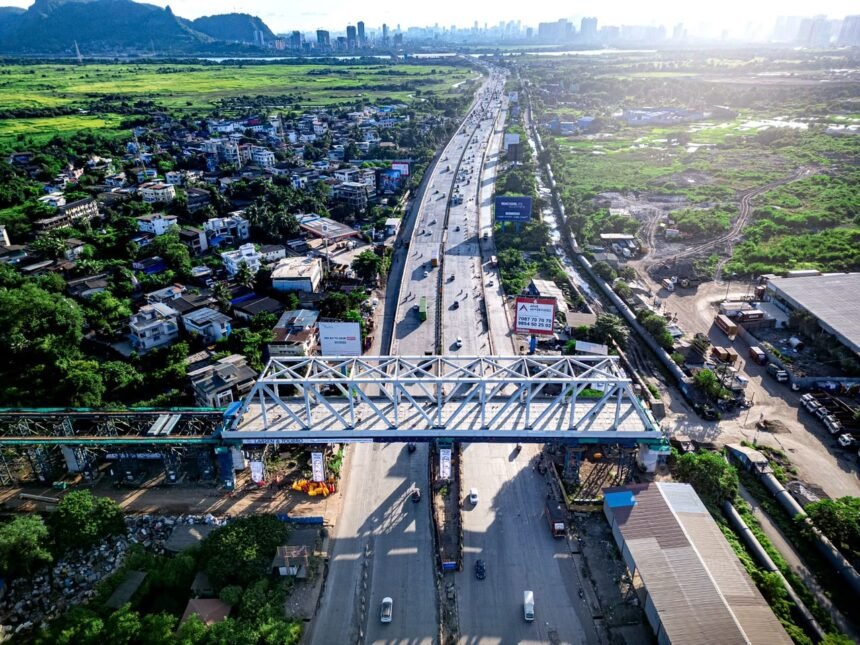
The 100-metre-long steel bridge, weighing around 1,405 tonnes, has been launched over NH-3, or the Nashik Highway, at Dive-Anjur village in Bhiwandi, Thane district.
The bridge is the first steel structure of the MAHSR project to be launched in Maharashtra. A total of 28 steel bridges are planned along the 508-km bullet train corridor, of which 16 have been completed so far. These structures are being used at locations where the high-speed rail alignment crosses highways, expressways, major rivers and railway lines, particularly where longer spans are required.
The bridge was fabricated at a dedicated workshop in Trichy, Tamil Nadu, nearly 1,300 km from its installation location in Maharashtra. After fabrication, the components were transported to Maharashtra on trailers and assembled at the site.
The fabrication process involved precision cutting, drilling, welding and painting in accordance with approved designs and specifications. Each batch of steel underwent Ultrasonic Testing (UT), while the welders and supervisors involved in the work were certified by international welding experts.
The main bridge is 14 metres wide and 14 metres high. At the installation site, the 100-metre structure was first assembled on temporary trestles at a height of around 17.5 metres above ground level.
The assembly involved 22 skid arrangements and 54,076 Tor-Shear Type High Strength Bolts (TTHSB). A C5 protective painting system and elastomeric bearings were also provided to improve durability and control vibrations.
Once the structure was fully assembled, it was moved into its final position using an automatic launching mechanism. The bridge now forms part of the elevated infrastructure being developed for the bullet train corridor in Maharashtra.
The Maharashtra section of the MAHSR corridor extends for 156 km and includes 135 km of elevated alignment, along with steel bridges, stations and mountain tunnels. The section is being developed as part of the larger 508-km corridor connecting Mumbai with Ahmedabad.