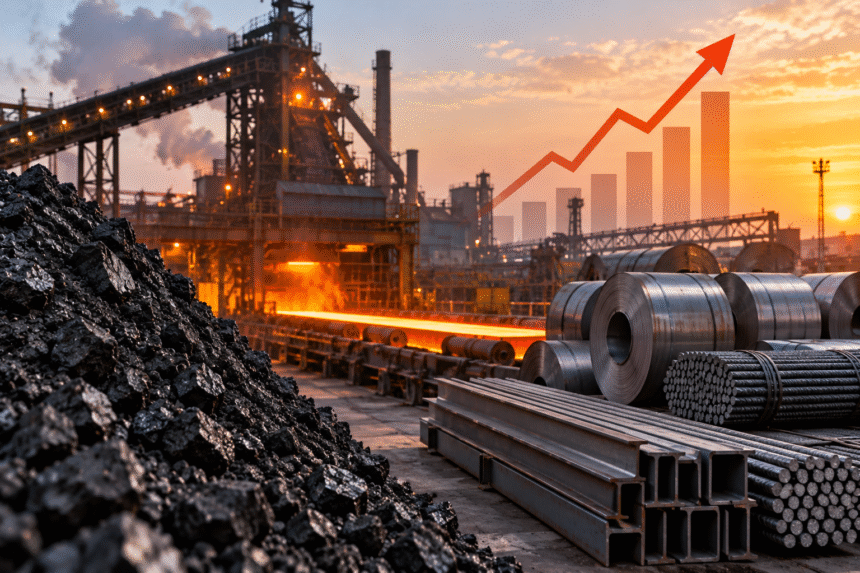
Indian steel prices are expected to rise further in the coming weeks as demand from the infrastructure and automotive sectors picks up after the monsoon, while higher coking coal costs continue to push up production expenses for steelmakers.
The expected increase could provide some relief to mills whose margins have been squeezed by rising input costs. At the same time, higher steel prices could add to costs for infrastructure, construction and automotive companies as activity gathers pace.
Domestic steel prices had remained relatively soft through June and July. Government data showed that prices of products such as hot-rolled coil (HRC) declined by around ₹280 per tonne during the period. The trend changed in August, with HRC prices climbing by ₹4,000 per tonne between August and early September, taking them to a four-year high, according to commodities consultancy BigMint.
Market expectations point to another increase. Vedant Goel, Director at Enlight Metals, expects steel prices to rise by around ₹3,500 per tonne in the coming weeks. The increase in coking coal prices is an important factor behind the upward movement, as the raw material represents a significant portion of steel production costs.
Supply conditions have also supported the recent price recovery. Planned maintenance shutdowns at major steel mills, tighter spot availability and low inventories among distributors have contributed to the increase. Post-monsoon restocking, festive demand and renewed project activity could provide further support to prices in the near term.
However, the scope for a sharp and sustained increase in steel prices could be limited by rising imports. Indian mills are already facing stronger competition from overseas suppliers, particularly China.
India introduced safeguard duties on certain steel imports last year and began an anti-dumping investigation in June covering HRC imports from China, Japan and Russia. Despite these measures, finished steel imports increased by 36.6% year-on-year between April and July, with India becoming a net importer during the period.
China accounted for 31% of India’s finished steel imports, making it the country’s largest supplier during the period. The increase in imports could restrict domestic producers’ ability to pass on higher costs, with Fitch Ratings identifying import pressure as a key risk to steelmakers’ margins.
For the domestic steel market, the coming weeks will therefore be shaped by two opposing forces: stronger post-monsoon consumption and higher production costs on one side, and growing import competition on the other. The balance between these factors will determine how much further steel prices can move.