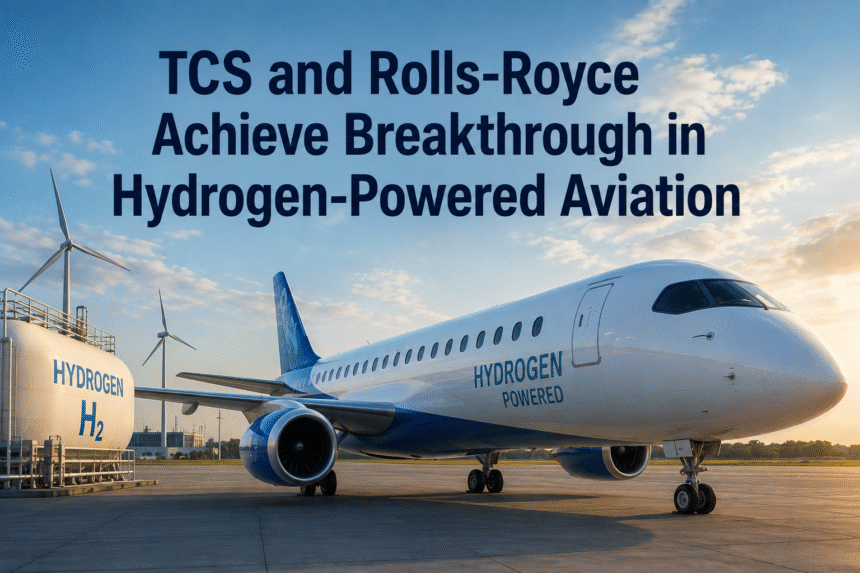
Tata Consultancy Services (TCS) and Rolls-Royce have achieved a significant milestone in hydrogen-powered aviation, successfully demonstrating the operation of a modern aero gas turbine through a fully simulated flight cycle using 100% hydrogen. The industry-first demonstration included simulated take-off, cruise and landing, providing important validation of hydrogen combustion, fuel systems and engine-control technologies.
The achievement is the culmination of a four-year hydrogen propulsion programme originally announced by Rolls-Royce and easyJet in 2022. TCS joined the programme in 2024, contributing its engineering and technology expertise to development, testing and validation activities
The demonstration focused on how a modern gas-turbine engine performs when operated entirely on hydrogen across different stages of a flight cycle. The successful test provides engineering insights into the behaviour of hydrogen as an aviation fuel and helps validate the systems required to integrate it into future aircraft propulsion architectures.
For TCS, the programme has involved work across several technically critical areas, including fuel-system and engine-controls integration, hydrogen combustion analysis, test preparation, validation, data analytics, risk management and detailed engineering design. Its role highlights the growing importance of digital engineering and advanced simulation alongside conventional aerospace expertise. The significance of the test extends beyond demonstrating that hydrogen can be combusted in an aero gas turbine. Hydrogen has different characteristics from conventional aviation fuels, requiring changes and careful validation across fuel delivery, combustion behaviour, controls and engine-system integration. The programme’s staged testing approach is intended to build knowledge that can inform future propulsion technologies.
Hydrogen is being explored as one potential pathway towards reducing aviation’s carbon footprint. When produced using low-carbon or renewable energy and used appropriately, hydrogen propulsion can eliminate in-flight CO₂ emissions from fuel combustion. However, its commercial deployment will also depend on factors such as hydrogen production, storage, transportation and airport refuelling infrastructure.
The collaboration brings together expertise from across the aviation ecosystem, including easyJet, NASA and the UK Health and Safety Executive, alongside Rolls-Royce and TCS. Such cross-industry partnerships are becoming increasingly important as aerospace companies explore propulsion technologies that could eventually complement or replace conventional fossil-fuel-based systems. The milestone is also relevant to the longer-term development of Rolls-Royce’s future propulsion technologies. The company has indicated that the knowledge gained through the hydrogen programme will contribute to future propulsion innovation, including work associated with its UltraFan technology.
For the aviation industry, the demonstration represents an important move from laboratory-level research towards increasingly realistic operating conditions. A successful full-flight-cycle simulation does not mean that commercial hydrogen aircraft are ready for deployment, but it provides valuable evidence that 100% hydrogen can be integrated into the combustion, fuel and control systems of a modern aero gas turbine.
The next challenge will be translating these technological advances into an aviation ecosystem capable of supporting hydrogen at scale. Aircraft design, fuel storage, airport infrastructure, safety standards and the availability of competitively priced low-carbon hydrogen will all influence the pace of adoption.
The TCS-Rolls-Royce achievement therefore marks an important step in the industry’s search for lower-carbon propulsion. By combining aerospace engineering, digital capabilities and hydrogen technology, the programme is helping build the technical foundation for a potential new generation of sustainable aviation.