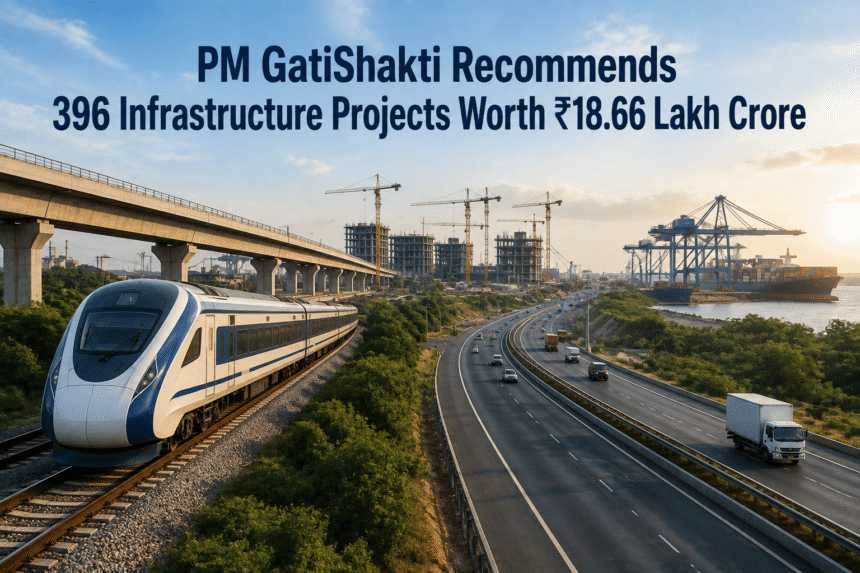
As many as 396 infrastructure projects with an estimated investment of ₹18.66 lakh crore have been evaluated and recommended for approval through the Network Planning Group (NPG) under the PM GatiShakti National Master Plan, according to government data. The projects span multiple ministries and include major connectivity sectors such as roads and railways.
Of the 396 projects evaluated through the NPG mechanism, 256 have been sanctioned, while 198 are currently under implementation. The figures highlight the scale at which the government is using integrated infrastructure planning to coordinate projects across different transport and economic networks.
Launched in October 2021, PM GatiShakti aims to bring greater coordination among ministries and departments involved in infrastructure development. The National Master Plan uses a digital platform to map existing and proposed infrastructure, enabling project planners to assess connectivity, avoid duplication and identify opportunities for multimodal integration.
The NPG mechanism is particularly important for large connectivity projects. Logistics and connectivity infrastructure projects involving investments above ₹500 crore are routed through the NPG, allowing them to be evaluated from a wider network-planning perspective rather than as isolated projects.
The approach is intended to improve the way different modes of transport connect with one another. Road projects, railway lines, ports, airports, waterways and logistics infrastructure can be planned with their interdependencies in mind, potentially improving cargo movement and reducing bottlenecks across supply chains.
The scale of the pipeline also reflects the government’s continuing emphasis on infrastructure-led economic growth. With ₹18.66 lakh crore worth of projects evaluated, the GatiShakti framework is increasingly becoming a key mechanism for screening and coordinating large infrastructure investments.
The implementation numbers, however, are equally significant. With 198 projects already under execution, the focus is gradually shifting from project identification and approval towards coordinated delivery. Effective execution, timely clearances, land availability and inter-agency coordination will remain crucial to converting the planned investment into operational infrastructure.
For India’s logistics sector, the integrated approach could have a wider impact. Better coordination between transportation modes can reduce unnecessary movement, improve freight efficiency and help bring down logistics costs—an important factor for the competitiveness of Indian manufacturing and exports.
The initiative also supports the broader objective of creating multimodal connectivity to economic zones, linking production centres and markets more efficiently. PM GatiShakti’s stated framework is built around coordinated infrastructure development rather than the expansion of individual networks in isolation.
PM GatiShakti is emerging as an important planning architecture for India’s next phase of infrastructure expansion. The effectiveness of the programme will ultimately be measured by how efficiently these projects translate into seamless connectivity, stronger logistics networks and lower movement costs across the country.