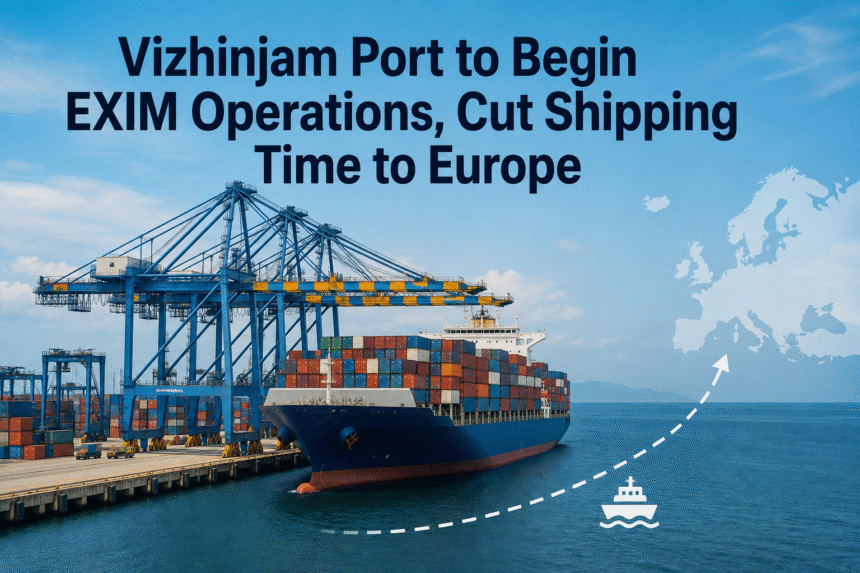
Kerala’s Vizhinjam International Seaport is set to begin export-import (EXIM) operations from August 18, marking a major shift from its current role as a transshipment hub to a full-fledged international cargo gateway. The development is expected to reduce logistics costs and transit times for Indian cargo moving to international markets, particularly Europe.
Vizhinjam’s strategic location close to the major east-west international shipping route gives it a significant advantage for connecting Indian cargo with markets in Europe, the Middle East and Southeast Asia. The port is located close to the international shipping lane, allowing large container vessels to call at the facility without substantial deviation from their main routes.
The commencement of EXIM services is expected to provide Indian exporters with a more direct maritime gateway, potentially reducing dependence on overseas transshipment hubs for certain cargo movements. The state government has highlighted the potential for shorter transit times, lower freight costs and improved supply-chain efficiency as key benefits of the transition.
The reported reduction in shipping time to Europe of around 18 days is particularly significant for time-sensitive cargo. Faster maritime connectivity can help exporters improve inventory planning, reduce working-capital requirements and strengthen their competitiveness in overseas markets.
Vizhinjam has already demonstrated rapid growth as a transshipment facility. Since beginning commercial operations, the port has handled 2 million TEUs within about 18 months and has attracted some of the world’s largest container vessels.
The EXIM launch is being implemented as part of Kerala’s broader Mission Samudra strategy, which seeks to build a maritime-led economic ecosystem by integrating ports with logistics, manufacturing, roads, railways, inland waterways and other supporting infrastructure.
However, the initial EXIM operations will operate under certain Customs restrictions. Since Vizhinjam does not yet have a designated Container Freight Station (CFS), import operations will initially be limited to eligible Full Container Load (FCL) shipments that can move directly to the importer’s premises. Export operations will focus on factory-stuffed, self-sealed or Customs-sealed FCL containers. Loose cargo, Less-than-Container Load shipments and containers requiring de-stuffing or CFS examination will not be permitted until a designated CFS becomes operational. Imported containers eligible for Direct Port Delivery are required to move directly from the terminal to the importer’s premises within 48 hours of landing.
The development is also expected to generate wider economic benefits for Kerala. Increased gateway cargo could stimulate demand for logistics services, warehousing, road transport, freight forwarding, customs services and maritime support activities, while creating new opportunities for exporters and manufacturers in the region.
Vizhinjam’s transformation is therefore significant beyond the port itself. Its combination of deep-water capability, proximity to international shipping routes, automation and growing transshipment volumes gives it the potential to become an important gateway for India’s international trade.