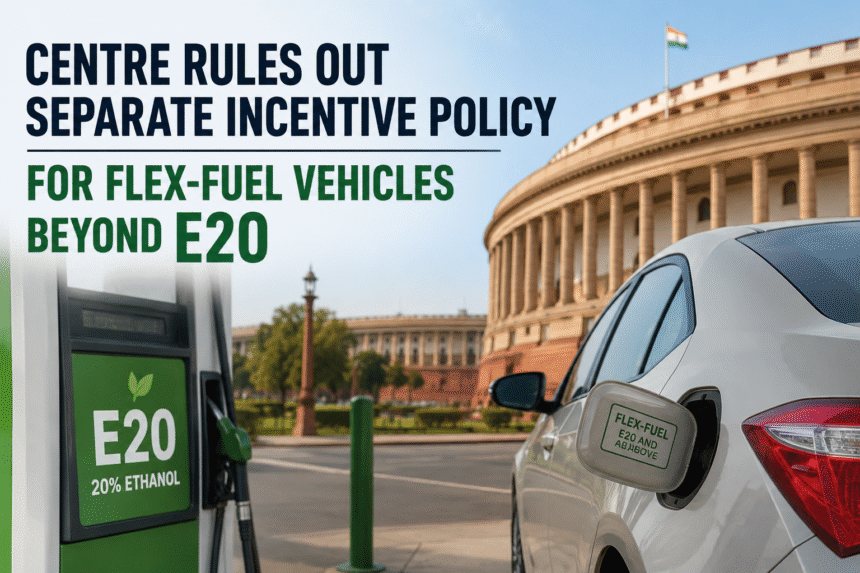
The Ministry of Heavy Industries (MHI) has clarified that the government is not considering a separate national policy to incentivise flex-fuel vehicles (FFVs) capable of operating on petrol blended with more than 20% ethanol. The clarification came in response to a parliamentary query, with the ministry stating that no dedicated phased incentive framework has been formulated for such vehicles.
The ministry also informed Parliament that it has not undertaken any study to assess the need for incentives specifically for flex-fuel vehicles or electric vehicles. Instead, the government will continue to support cleaner mobility through its existing policy framework, including the National Policy on Biofuels, which promotes ethanol blending while balancing food security, water sustainability and farmers’ interests.
India has already achieved nationwide implementation of E20 petrol and is pursuing higher ethanol blending as part of its broader strategy to reduce dependence on imported crude oil and strengthen energy security. While draft regulations have been proposed to enable the use of higher ethanol blends such as E85 and E100, the government has indicated that these measures do not translate into a separate incentive programme for flex-fuel vehicles.
The clarification underscores the Centre’s approach of advancing the country’s biofuel programme through existing policy mechanisms rather than introducing additional incentives for flex-fuel vehicles. The government maintains that ethanol blending will continue to be expanded in a calibrated manner, taking into account environmental sustainability, agricultural priorities and long-term energy transition objectives.