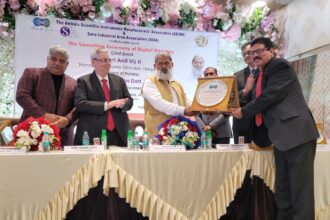
Sarbananda Sonowal has launched the Logistics Port Performance Index (LPPI) for FY 2024–25 along with a series of digital governance initiatives aimed at improving efficiency, transparency, and ease of doing business across India’s maritime sector.
The initiatives were unveiled during the 37th Foundation Day celebrations of Jawaharlal Nehru Port Authority (JNPA) as part of the government’s broader maritime modernisation strategy.
The LPPI, developed under the Sagar Aankalan framework, has been introduced as a national benchmarking mechanism to assess and improve the operational performance of Indian ports. The index aligns with key national infrastructure programmes including PM Gati Shakti, Maritime India Vision 2030, and Maritime Amrit Kaal Vision 2047.
According to officials, the index evaluates ports across dry bulk, liquid bulk, and container cargo segments using operational parameters such as cargo handled, vessel turnaround time, berth idle time, pre-berthing waiting time, container dwell time, and ship berth day output.
Speaking on the occasion, Sonowal said, “We have introduced the Logistics Port Performance Index (LPPI) for FY 2024-25. It is a major step towards improving the efficiency, transparency & global competitiveness of Indian ports. By promoting continuous improvement & global benchmarking, it will strengthen India’s position as a leading maritime power.”
Alongside the LPPI, the ministry launched four digital initiatives developed by the Directorate General of Shipping (DGS) to improve governance, service delivery, and accountability across the maritime ecosystem.
The initiatives include:
•A 24×7 Grievance Redressal Module under the e-Navik platform
•A Ship Registration Module on the e-Samudra platform
•A Medical Practitioner Module
•A Unified Ship Recycling Credit Note Module
Officials stated that these platforms are designed to strengthen digital governance, streamline maritime services, improve stakeholder engagement, and enhance transparency for seafarers, ship owners, and maritime businesses.
The Unified Ship Recycling Credit Note Module is expected to support the government’s shipbuilding and ship recycling ecosystem by enabling incentives linked to compliant recycling practices at Indian shipyards.
The launch comes as India continues expanding investments in port infrastructure, shipping capacity, logistics integration, coastal connectivity, and digital maritime systems to improve global trade competitiveness.
Officials highlighted that India’s ranking in the World Bank’s Logistics Performance Index has improved significantly in recent years, while multiple Indian ports have featured among the world’s top-performing container ports.
Industry experts believe the LPPI and the new digital governance platforms could play a major role in improving port productivity, reducing logistics costs, enhancing operational transparency, and strengthening India’s position as a global maritime and logistics hub.